
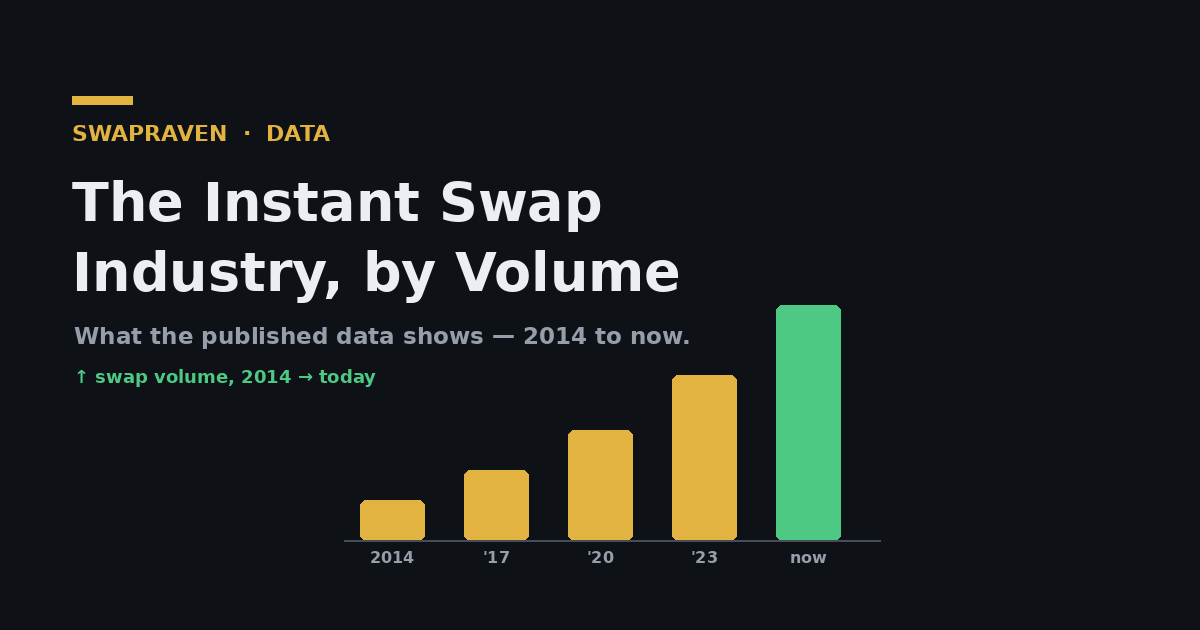
How big is the instant-swap industry, and how much money actually moves through it? It's a deceptively hard question, because the answer splits in two: the on-chain swap economy is exhaustively documented in public data, while the centralized, no-account "instant swap" services are mostly private companies that publish little audited volume. This article pulls together the published record — from the first hard numbers in 2014 through today — links the primary sources, and documents the trend. A separate section at the end speculates, clearly labeled, on the parts that aren't published.
Why the data splits in two
"Instant swap" covers two overlapping things:
- No-account, address-based swap services (the ShapeShift/Changelly/ChangeNOW lineage). These are operated by private firms. A few have shared milestones, but there's no audited, continuous public volume feed — so hard numbers are scarce.
- On-chain swaps — decentralized exchanges and cross-chain protocols. Every trade is recorded on a public blockchain, so aggregators like DeFiLlama publish volume down to the dollar. This is where the documented trend is clearest.
So the honest picture is: we have excellent public data for on-chain swaps, a handful of published figures for the early centralized pioneers, and mostly silence from today's no-KYC swap operators.
Since the beginning: the first documented numbers (2014–2018)
The modern instant swap began with ShapeShift, founded July 1, 2014 (Wikipedia). Its early growth produced some of the only published figures from that era:
- By its March 2017 Series A ($10.4M), ShapeShift reported volume had grown past ~50,000 BTC per month — worth roughly $50–60 million/month at early-2017 bitcoin prices — having grown an average of ~48% per month since launch (Cointelegraph, CoinReport).
- A 2018 Wall Street Journal investigation alleged ShapeShift had processed about $90 million of funds tied to criminal activity over a two-year window — itself a (narrow) documented data point on throughput (as summarized on Wikipedia).
- October 1, 2018: ShapeShift began requiring KYC (Wikipedia), and in 2021 pivoted to a decentralized model to shed those rules (CoinDesk).
For history on this period, see A History of Instant Swaps. The takeaway for volume: a single leading provider was moving tens of millions of dollars a month by 2017 — and that was before the category fragmented.
The published record: on-chain swap volume (2018–now)
After the KYC turn, the most reliable, continuously-published swap data comes from on-chain venues. It documents an explosive trend:
Decentralized exchange (spot) swaps
- Uniswap, the largest on-chain swap venue, surpassed $4 trillion in cumulative trading volume, per Uniswap Labs (report). The acceleration is the story: it took ~4 years to reach the first $1T (2022), then $2T, $3T, and $4T in ever-shorter spans.
- In 2025 alone, Uniswap processed 900M+ swaps and over $1 trillion in volume (Yahoo Finance); live figures are on DeFiLlama.
Cross-chain swaps (the closest on-chain analogue to BTC↔XMR-style instant swaps)
- THORChain, which does native cross-chain swaps, has processed roughly $123 billion in cumulative swap volume per DeFiLlama — a hard, on-chain number for the "send one chain's coin, receive another's" model.
One caveat to avoid confusion: headlines about DEXs crossing $1 trillion in a single month usually refer to perpetual-futures (derivatives) volume, not spot swaps (e.g. CryptoSlate). Those are leveraged contracts, not coin-for-coin swaps, so we keep them out of the swap totals here.
The documented trend, in one line
From a single pioneer moving ~50,000 BTC/month in 2017, to on-chain spot swaps measured in the trillions cumulatively and cross-chain swap protocols in the $100B+ range today, the direction is unambiguous: swap-style trading has gone from a niche convenience to a core piece of crypto market structure. The 2018 KYC turn didn't shrink it — it split it into a regulated/on-chain track (well-documented) and a no-KYC centralized track (poorly documented).
Today's centralized no-KYC swaps: what's actually published
The current no-account instant swaps and aggregators (ChangeNOW, Changelly, and many others) rarely publish audited volume. What they do publish is mostly self-reported engagement, not throughput — for example, ChangeNOW (operating since 2017) advertises 8M+ users (self-reported; see CoinPaprika review), and Changelly has operated since 2015. Treat these as marketing metrics, not verified volume.
Speculation: the unpublished volume (clearly labeled)
The following is informed estimation, not published data. Because the centralized no-KYC swap segment doesn't disclose audited volume, its true size can only be inferred:
- From on-chain footprints. These services use hot wallets and one-time deposit addresses on public chains; researchers can (and do) cluster those addresses to approximate flows — but no operator confirms the totals, so any figure is an estimate.
- From user counts. If a provider genuinely has millions of users doing periodic swaps, even modest average swap sizes imply billions per year across the segment — but "users" is a soft, self-reported number.
- From the delisting effect. As regulated exchanges dropped privacy coins (see Monero Delistings), demand for acquiring them shifted to no-KYC swaps. That almost certainly grew the segment — but the migration isn't quantified in any public dataset.
Our reasoned guess: the no-KYC centralized swap segment plausibly moves in the low single-digit billions of dollars per year in aggregate — small next to Uniswap's trillions, but meaningful and growing. We flag this as speculation precisely because, unlike the on-chain figures above, there is no audited source to cite.
Why the documented view matters
The published data tells a clear story; the unpublished part requires honesty about its limits. SwapRaven exists to bring transparency to this space — grading instant swap exchanges on trust, fees, supported coins, and KYC/AML posture, so the choices are clear even where the volume figures aren't. Browse the directory to compare vetted, no-KYC instant swaps.
Sources
- ShapeShift history, WSJ $90M figure, KYC date — en.wikipedia.org/wiki/ShapeShift
- ShapeShift ~50,000 BTC/month, $10.4M Series A — Cointelegraph, CoinReport
- ShapeShift → DeFi pivot — CoinDesk
- Uniswap $4T cumulative volume — Phemex News; 2025 swaps — Yahoo Finance; live data — DeFiLlama
- THORChain ~$123B cumulative cross-chain swap volume — DeFiLlama
- Perp-DEX vs spot distinction — CryptoSlate
- ChangeNOW (2017, self-reported users) — CoinPaprika
Comments (0)
Leave a comment